Font Directory
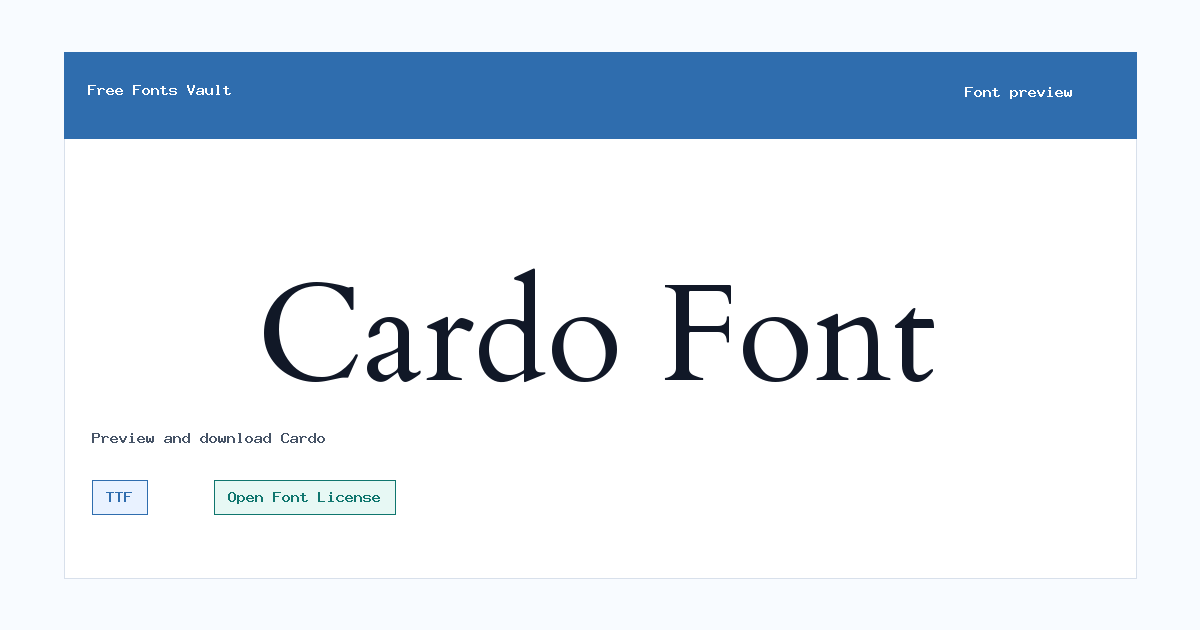
Cardo
Cardo includes 3 downloadable variants for live preview and testing.
Styles in this family
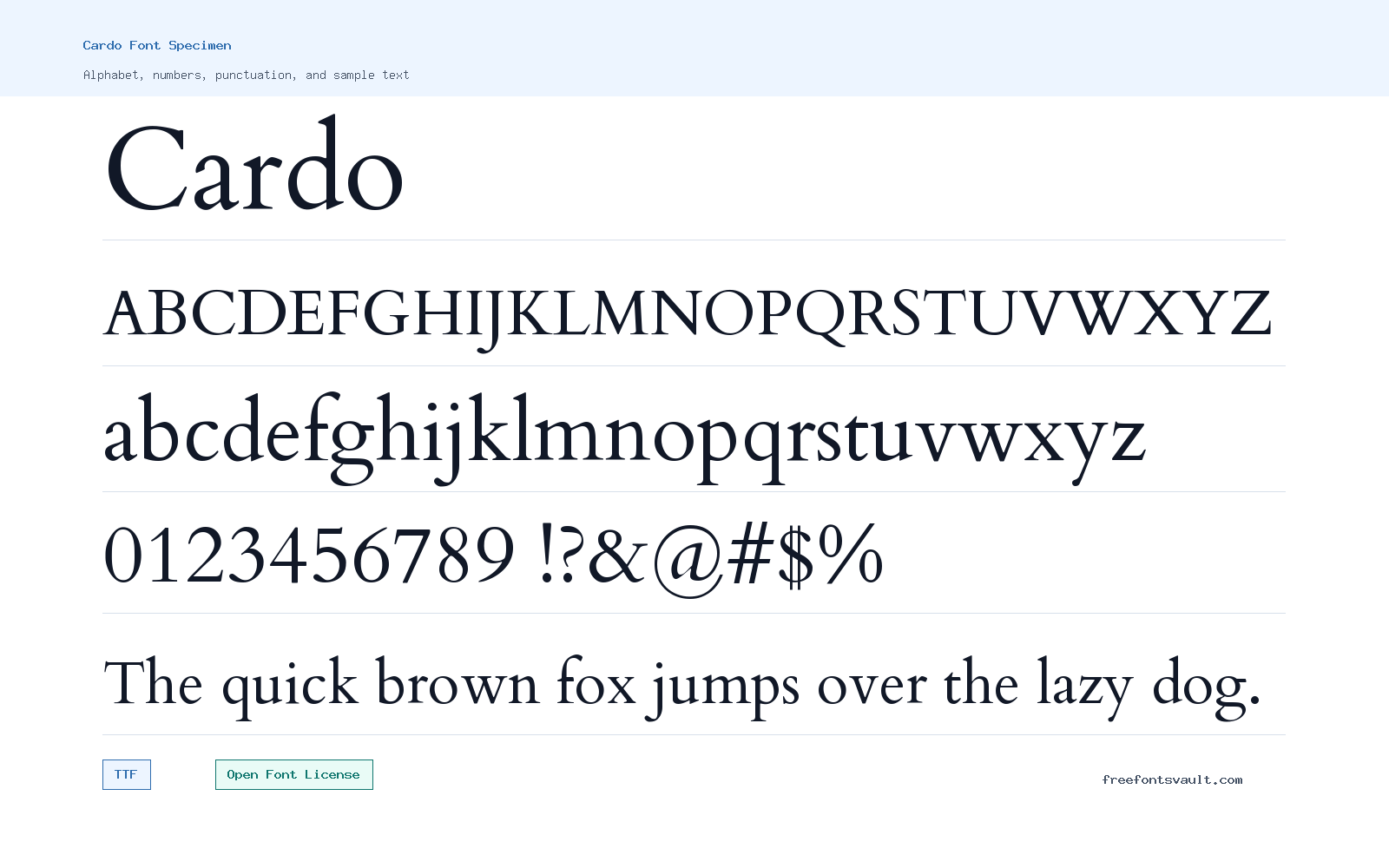
Font Specimen
Details
- Designer David J. Perry
- Foundry David J. Perry
- License Open Font License
- License URL scripts.sil.org/OFL
- Format TTF
- Variants 3 files available
Cardo font.
Cardo is a serif font family by David J. Perry. It has a bookish, old-style look and comes in regular, italic, and bold TTF styles, making it useful for readable text, quotations, headings, and academic-style design.
About Cardo
Cardo is built as a serious serif rather than a decorative display face. Google Fonts classifies it as an Old Style serif, and its proportions make it feel suited to longer reading, formal layouts, and pages where a calm text face is more useful than a loud headline font. The family on the download lists regular 400, italic 400, and bold 700, so you can set body text, emphasis, and stronger headings without switching families.
Cardo is also known for scholarly use. The project information describes support for Latin, Greek, Hebrew, IPA, combining marks, punctuation, and other characters useful in classical, biblical, linguistic, and textual work. If you need a font for ordinary English text, it can still work well; if you need specialist characters, test your exact words in the preview before downloading so you can confirm coverage and spacing.
Cardo gives you regular, italic, and bold styles, which makes it more flexible than a single-display download. Use the regular style for a calm serif base, the italic for quotations or emphasis, and bold when a heading needs more authority. This makes Cardo practical for editorial layouts, academic-style pages, and classic reading-focused designs.
Features
- Old Style serif design with a traditional reading feel
- Regular, italic, and bold TTF styles for text, emphasis, and headings
- Broad Unicode coverage noted in project materials, including Latin, Greek, Hebrew, IPA, and scholarly punctuation
- Licensed under the SIL Open Font License 1.1
Best Uses
- Book-style body text, essays, articles, and long-form pages
- Academic, classical, biblical, linguistic, or historical text projects
- Quotations, footnotes, captions, and readable editorial layouts
- Formal headings paired with a simple sans serif
License Information
Cardo is licensed under the SIL Open Font License, Version 1.1. The OFL allows broad use, but redistribution, modification, and renamed versions must follow the license terms. Keep the license with the font files when sharing them.
Designer and Foundry
Cardo was designed by David J. Perry, whose Fonts for Scholars site focuses on Unicode fonts and tools for scholarly text work.
Usage Tips
Use Cardo when you want a readable serif with a traditional tone. For websites, try the regular style for body copy and reserve bold for short headings. Test small sizes, diacritics, Greek, Hebrew, and specialist symbols in the preview if your project depends on exact character support. Keep decorative pairings simple. Cardo already has a formal serif voice, so a neutral sans serif often works best beside it.
FAQ
Is Cardo free to use?
Cardo is licensed under the SIL Open Font License 1.1, which permits broad use under its terms. Review the OFL if you plan to redistribute or modify the font.
What styles are included?
The listed files include Cardo Regular in TTF format, Cardo Italic in TTF format, and Cardo Bold in TTF format.
Who designed Cardo?
Cardo was designed by David J. Perry.
Is Cardo good for body text?
Yes. Cardo is an Old Style serif, and its regular style is suitable for readable paragraphs, essays, and editorial pages. Always check the preview at your intended size.
Does Cardo support scholarly characters?
Project information notes broad Unicode coverage, including Latin, Greek, Hebrew, IPA, combining marks, and scholarly punctuation. Test your exact text if you need specialized characters.
Does Cardo include bold and italic styles?
Yes. The listing has Regular, Italic, and Bold TTF files.
Browse More Fonts
Want to browse beyond this family? Return to All Fonts for the main directory.